Hair graying is one of the most visible signs of aging and often carries significant cosmetic and emotional concerns. While countless products claim to restore natural hair color, there is currently no scientifically proven treatment that can consistently reverse gray hair.
However, a published clinical case report has highlighted an intriguing possibility: a treatment originally designed for male pattern hair loss may also improve hair pigmentation and reduce the appearance of gray hair.
Researchers from several dermatology and laser clinics in Seoul, South Korea, reported the case of a 55-year-old man with male pattern hair loss who experienced noticeable improvement in hair graying while undergoing a specialized hair restoration treatment.
The study, published in Medical Lasers: Engineering, Basic Research, and Clinical Application (2017), investigated a combination therapy consisting of:
While the primary goal was to treat male pattern hair loss, researchers observed an unexpected improvement in the patient’s gray hair.
Hair graying occurs when pigment-producing cells known as melanocytes gradually lose their ability to produce melanin.
Several biological mechanisms are believed to contribute to this process, including:
Researchers have identified oxidative stress as one of the most important contributors to age-related hair graying. Over time, oxidative damage can impair melanocyte stem cells, preventing them from replenishing pigment-producing cells within the hair follicle.
As a result, newly growing hair loses its color and appears gray or white.
The patient underwent a total of 12 weekly treatment sessions.
A 1,927-nm fractionated thulium laser (LASEMD™) was applied to the scalp.
Treatment parameters included:
The laser was applied across the scalp areas affected by hair loss.
Following laser treatment, physicians injected:
The injections were delivered into the deep dermis around hair follicles in:
PDRN is a regenerative compound known for promoting tissue repair and reducing oxidative stress.
Immediately after treatment, a specialized growth factor solution was applied to the scalp.
The solution contained:
These ingredients were selected for their regenerative and protective effects on hair follicles.
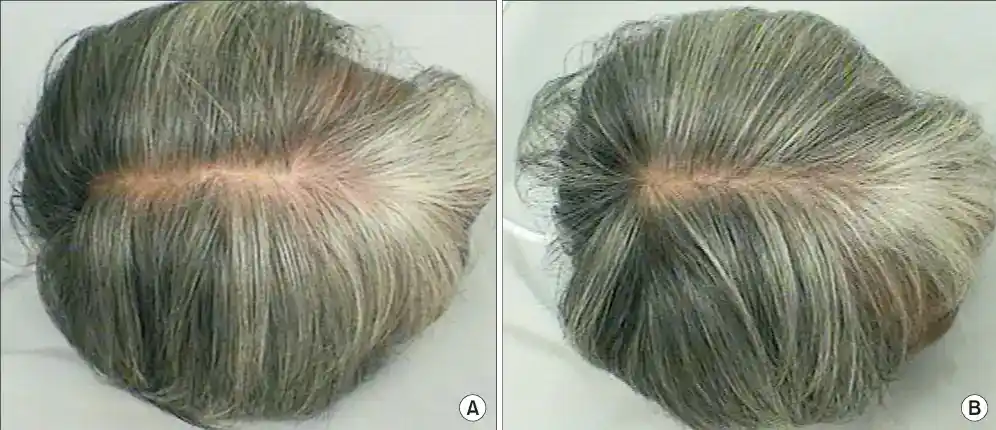
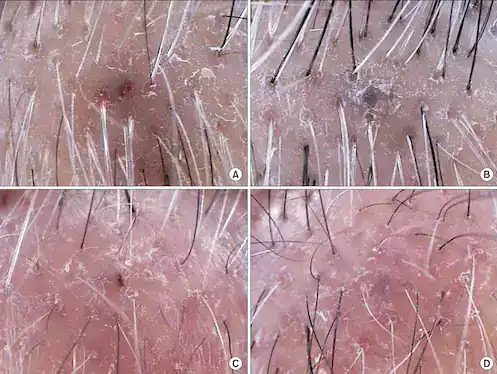
Researchers captured standardized digital images before treatment and one week after the final session using a computerized scalp imaging system.
The results demonstrated improvements not only in hair growth but also in hair pigmentation.
The patient reported satisfaction with:
These findings were consistent with previous research on the effectiveness of this treatment combination for male pattern hair loss.
More surprisingly, researchers observed:
Magnified scalp images showed a clear increase in pigmented hair shafts after treatment.
The before and after hair loss treatment photographs revealed measurable improvement in both hair density and hair color.
Although the exact mechanism remains uncertain, researchers proposed several theories.
Oxidative stress is considered one of the primary causes of hair graying.
Previous studies have shown that PDRN can significantly reduce oxidative damage in tissues.
By lowering oxidative stress levels around the hair follicle, PDRN may help preserve melanocyte stem cell function.
KGF has demonstrated antioxidant properties in laboratory studies.
Researchers believe KGF may protect pigment-producing cells from oxidative injury, potentially supporting long-term pigmentation.
Earlier studies suggested that fractionated thulium laser treatment may stimulate follicular stem cells and progenitor cells.
The laser-induced healing response may encourage regeneration within the hair follicle environment, potentially benefiting melanocyte stem cells as well.
The authors theorized that:
Together, these effects may have helped melanocyte stem cells repopulate and restore pigmentation in previously gray hairs.
While the findings are promising, several limitations must be considered.
This report involved:
The authors emphasized that larger clinical trials are needed before this treatment can be considered an established therapy for gray hair reversal.
Although the study showed promising results, researchers noted several limitations:
The authors concluded that larger randomized controlled trials are needed to further confirm the effectiveness of this treatment combination.
At present, hair dyes remain the most common and reliable way to conceal gray hair.
However, this case report suggests that regenerative hair restoration treatments may eventually offer benefits beyond hair growth alone.
The study provides early evidence that combining:
could potentially improve both hair density and hair pigmentation.
Although more research is necessary, the findings open the door to future therapies that may help address both male pattern hair loss and age-related hair graying simultaneously.
This clinical case report documented an unexpected improvement in gray hair during treatment for male pattern hair loss. After 12 sessions of fractionated thulium laser therapy, PDRN injections, and topical growth factor application, the patient experienced increased hair density, thicker hair shafts, and a noticeable increase in pigmented hairs.
The before and after hair loss treatment results suggest that regenerative therapies targeting oxidative stress and follicular stem cell activity may hold future potential for reversing some aspects of hair graying. While these findings are encouraging, larger clinical studies are required to determine whether this approach can consistently restore hair pigmentation in broader patient populations.
In rare cases, gray hair may regain pigmentation if the underlying cause is addressed. However, age-related hair graying is generally considered a progressive process. Researchers continue to investigate treatments that may help restore melanocyte function and hair pigmentation.
The study did not determine whether the improvements were permanent. Since the report involved only one patient and a short follow-up period, more research is needed to understand the long-term effects of the treatment.
Most hair loss treatments are designed to increase hair growth and density, not restore hair color. However, this clinical case report documented an unexpected improvement in hair pigmentation during treatment with a 1,927-nm fractionated thulium laser, PDRN injections, and growth factor therapy.
A 1,927-nm fractionated thulium laser is a laser technology commonly used in dermatology for skin rejuvenation and tissue remodeling. In this study, researchers used the laser on the scalp as part of a treatment protocol for male pattern hair loss.
Polydeoxyribonucleotide (PDRN) is a regenerative compound derived from DNA fragments. It has been studied for its ability to support tissue repair, improve healing, reduce inflammation, and decrease oxidative stress, which may help create a healthier environment for hair follicles.
After 12 weekly treatment sessions, the patient showed improvements in hair density, hair thickness, and the number of pigmented hairs. The before and after hair loss treatment images demonstrated increased hair growth along with visible improvements in hair color at the frontal hairline and vertex scalp.
The KeraLase system combines the UltraLaseMD fractional laser with KeraFactor’s 7-growth-factor serum — stimulating dormant follicles and building real, measurable thickness. No needles. No downtime. Just results.

added to your account
when you connect with us