Hair loss remains one of the most common aesthetic and dermatological concerns among men worldwide. While medications such as minoxidil and finasteride have long been considered standard treatments, newer technologies are expanding the options available for patients seeking hair restoration. One promising advancement is the use of the 1927-nm fractionated thulium laser, a device designed to stimulate hair growth while also improving the scalp environment that supports healthy follicles.
A clinical study published in Lasers in Medical Science evaluated the therapeutic efficacy and safety of a 1927-nm fractionated thulium laser for treating pattern hair loss (PHL). The study investigated not only whether the laser could improve hair growth on its own, but also whether combining laser treatment with a growth factor solution could enhance the results.
The findings demonstrated measurable improvements in both hair density and hair thickness, offering compelling evidence that this laser technology may represent an effective non-surgical option for individuals experiencing androgenetic alopecia.
Pattern hair loss, also known as androgenetic alopecia, is characterized by the gradual miniaturization of hair follicles. Over time, affected follicles produce thinner, shorter hairs until they eventually stop generating visible hair growth altogether.
Researchers have increasingly focused on therapies that can improve the perifollicular environment—the tissue surrounding hair follicles. Previous studies have suggested that laser and light-based treatments may stimulate cellular activity, enhance blood supply, and increase the production of growth factors involved in hair regeneration.
The 1927-nm fractionated thulium laser was developed with these mechanisms in mind.
The thulium laser emits energy at a wavelength of 1927 nanometers, which is highly absorbed by water in the skin. This allows physicians to create controlled zones of thermal stimulation without causing significant damage to surrounding tissue.
Compared to some more aggressive laser systems, the thulium laser can deliver precise energy into the epidermis and upper-to-mid dermis while preserving the structural integrity of hair follicles. This controlled thermal effect is believed to trigger biological responses that support hair growth and follicular regeneration.
Researchers also theorized that the microscopic treatment channels created by the laser could enhance transdermal delivery of growth-promoting ingredients applied after treatment.
To evaluate both efficacy and safety, the researchers conducted several phases of investigation.
First, laboratory studies were performed using hairless mice to examine how the laser interacted with skin tissue under different power and energy settings.
An additional environmental scanning electron microscopy (ESEM) study was performed on human skin to visualize the microscopic changes created immediately after laser treatment.
Following these preliminary evaluations, a prospective evaluator-blinded split-scalp clinical study was conducted involving 10 Korean male patients diagnosed with pattern hair loss.
The participants had an average age of 42.6 years, with ages ranging from 25 to 69 years.
Patients who had recently received hair-loss treatments—including minoxidil, finasteride, dutasteride, platelet-rich plasma (PRP), mesotherapy, laser treatments, or hair transplantation—were excluded to ensure the results reflected the effects of the thulium laser alone.
Each participant underwent 12 treatment sessions using the 1927-nm fractionated thulium laser at weekly intervals.
Treatment was performed across the frontal scalp, mid-scalp, and vertex regions. Approximately 100 to 140 laser pulses were delivered during each session.
Notably, procedures were performed without local anesthesia, highlighting the relatively tolerable nature of the treatment.
Immediately following each laser session, researchers randomly selected one half of the scalp to receive a growth factor-containing solution. The opposite half received no topical treatment and served as a comparison area.
The growth factor formulation contained:
Participants continued applying the growth factor solution daily to the designated side of the scalp for 12 weeks.
The animal studies revealed that the laser created inverted cone-shaped zones of controlled thermal coagulation within the epidermis and dermis.
Importantly, there was no significant tissue destruction and no evidence of harmful injury to hair follicles.
Within three days of treatment, researchers observed increased fibroblast activity and inflammatory responses associated with wound healing and tissue remodeling.
After seven days, the epidermis had largely recovered, while collagen production and fibroblast activity remained elevated.
Most notably, no signs of scarring were detected.
These findings suggested that the laser successfully stimulated biological repair mechanisms while preserving healthy follicular structures.
The human skin microscopy study provided further insight into how the laser works.
Immediately after treatment, researchers observed multiple microscopic zones of non-ablative thermal coagulation on the skin surface.
These microscopic treatment channels appeared capable of facilitating transdermal drug delivery without causing significant tissue damage.
This observation helps explain why the addition of a growth factor solution produced even better outcomes than laser treatment alone.
One of the most impressive findings involved increases in hair count.
At the central scalp evaluation point, average hair counts increased from 163.7 hairs at baseline to:
All improvements were statistically significant.
The split-scalp comparison revealed even stronger results on the side treated with both laser therapy and the growth factor solution.
Hair counts on the combination-treatment side increased from 178.2 hairs at baseline to:
These findings suggest that growth factor application enhanced the laser’s ability to improve hair density.
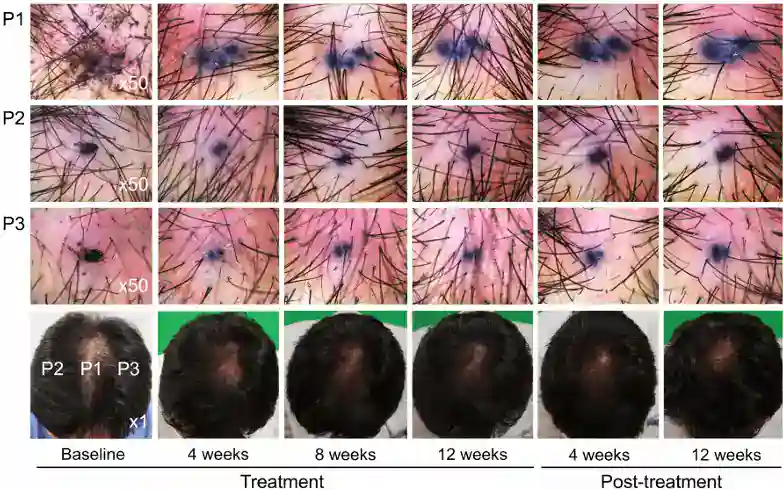
Hair shaft thickness also improved significantly throughout the study.
Average hair thickness increased from approximately 0.047 mm at baseline to roughly 0.06 mm after treatment.
While some decline occurred during follow-up, hair thickness remained significantly greater than baseline levels even three months after the final session.
For many patients, thicker hair shafts contribute substantially to the visible improvement seen in before and after hairloss treatment photos because thicker hairs create greater scalp coverage and fullness.
The study’s clinical outcomes indicate that patients experienced meaningful improvements in both the number of hairs and the diameter of existing hairs.
When evaluating before and after hairloss treatment outcomes, increases in hair density and thickness are among the most important markers of success because they directly influence overall hair volume and visual scalp coverage.
The data suggest that thulium laser therapy may not simply preserve existing hair but may also stimulate biological processes that encourage follicular regeneration and improve follicle performance.
The addition of topical growth factors appears to further amplify these benefits.
As a result, patients reviewing before and after hairloss treatment results may notice fuller-looking hair, improved scalp coverage, and stronger individual hair shafts following a treatment course.
Although the exact biological mechanisms remain under investigation, researchers proposed several explanations for the observed improvements.
The laser may stimulate dormant follicles through controlled photothermal effects, similar to mechanisms observed in platelet-rich plasma treatments.
Repeated micro-injury from laser treatment may also activate wound-healing pathways associated with hair follicle regeneration.
Another possibility involves activation of Wnt signaling pathways, which have been linked to new hair follicle formation in previous research.
Additionally, the microscopic channels produced by the laser may allow growth-promoting compounds to penetrate deeper into the scalp, enhancing their effectiveness.
Rather than relying on a single mechanism, the treatment likely works through multiple complementary biological pathways.
Safety was a major focus of the investigation.
Overall, treatment was very well tolerated.
Reported side effects included:
All symptoms resolved spontaneously within a few days.
Importantly, researchers observed no:
None of the participants experienced progression of their pattern hair loss during the study period.
Interestingly, several patients with seborrheic dermatitis actually experienced improvements in their scalp condition during treatment.
While the results are encouraging, the researchers emphasized that this was a pilot study involving only 10 patients.
Larger randomized clinical trials are needed to confirm the findings and determine the long-term durability of the results.
The study also followed patients for only three months after completing treatment, leaving questions about maintenance protocols and long-term outcomes.
The 1927-nm fractionated thulium laser demonstrated significant potential as a treatment for pattern hair loss. Across 12 weekly treatment sessions, patients experienced measurable increases in both hair density and hair thickness with minimal side effects.
The combination of laser therapy and topical growth factor application produced the strongest outcomes, suggesting that laser-assisted delivery may play an important role in future hair restoration strategies.
For individuals seeking a non-surgical approach to hair restoration, this study provides compelling evidence that thulium laser technology may offer meaningful improvements in before and after hairloss treatment results while maintaining an excellent safety profile. Although larger studies are still needed, the findings represent an important step forward in the evolving field of hair loss treatment.
According to the clinical study, patients who received 12 weekly sessions of 1927-nm fractionated thulium laser treatment experienced significant improvements in both hair density and hair thickness. Researchers found that hair counts increased noticeably compared to baseline measurements, suggesting that the treatment may help stimulate hair growth in individuals with pattern hair loss.
The study did not determine whether the improvements were permanent. Since the report involved only one patient and a short follow-up period, more research is needed to understand the long-term effects of the treatment.
Most hair loss treatments are designed to increase hair growth and density, not restore hair color. However, this clinical case report documented an unexpected improvement in hair pigmentation during treatment with a 1,927-nm fractionated thulium laser, PDRN injections, and growth factor therapy.
A 1,927-nm fractionated thulium laser is a laser technology commonly used in dermatology for skin rejuvenation and tissue remodeling. In this study, researchers used the laser on the scalp as part of a treatment protocol for male pattern hair loss.
Polydeoxyribonucleotide (PDRN) is a regenerative compound derived from DNA fragments. It has been studied for its ability to support tissue repair, improve healing, reduce inflammation, and decrease oxidative stress, which may help create a healthier environment for hair follicles.
After 12 weekly treatment sessions, the patient showed improvements in hair density, hair thickness, and the number of pigmented hairs. The before and after hair loss treatment images demonstrated increased hair growth along with visible improvements in hair color at the frontal hairline and vertex scalp.
The KeraLase system combines the UltraLaseMD fractional laser with KeraFactor’s 7-growth-factor serum — stimulating dormant follicles and building real, measurable thickness. No needles. No downtime. Just results.

added to your account
when you connect with us